Library Journal has an interesting article about how the economy has affected the University of California Berkeley libraries and how people responded. Due to budget strains, the university decided to close many libraries on Saturdays and to limit exam period hours at one library. Well, many students, parents, and faculty did not take kindly to these cuts. A group of people occupied one of the libraries in protest of the reduced hours. Also, parents of alumni donated $80,000 so that the libraries could return to the previous hours of operation. The decisions to cut hours and limit access at the libraries have now been reversed due to the work of these people.
This article made me wonder how many other academic libraries are facing budget concerns. Will more and more libraries have to make decisions similar to those made by the University of California Berkeley? If so, how will these decisions impact students and faculty who depend on the libraries for study, research, and resources? Budget problems could result in cuts other than just reduced hours. For example, maybe an academic library will have to reduce the number of databases it subscribes to. Overall, budget cuts could potentially cause major changes at academic libraries. Librarians and patrons alike will have to deal with the changes.
The University of California Berkeley was able to recover from the cuts it made, largely due to very generous donations. However, not all academic libraries will be able to find donors to give large sums of money. The University of California Berkeley is a very prominent school so it was able to get donations. I do not think the library of a small college with less exposure, for example, would be able to get the same kinds of donations. Thus, many academic libraries will have to find different solutions or be forced to cope with budget cuts and their affects.
Friday, October 23, 2009


Sunday, October 18, 2009
When Places of Refuge Need Help


The Boston Globe article, “Library budget cuts put book borrowing at risk” by Eric Moskowitz, reports that some public libraries in Massachusetts are jeopardizing their certification with the Board of Library Commissioners.
What does this mean?
Without the certification, “libraries would not be eligible for the state grants that round out local library budgets, and their residents would be deprived of the ability to borrow from most other public libraries.” Without the ability to make interlibrary loans, each public library would become its own entity. The problem with this is that libraries are mean to serve the public, and this is best achieved through pooling mass resources like books, audios, and videos.
What does this mean?
Without the certification, “libraries would not be eligible for the state grants that round out local library budgets, and their residents would be deprived of the ability to borrow from most other public libraries.” Without the ability to make interlibrary loans, each public library would become its own entity. The problem with this is that libraries are mean to serve the public, and this is best achieved through pooling mass resources like books, audios, and videos.
One example of this single entity problem is when a library book club selects a book of the month. They are left with few options: to base the book off of if the library has enough copies or to buy your own copy, which defeats the purpose of a library. Without interlibrary loans, this book club may not be possible. Libraries need their certification to receive book loans.
14 out of 348 local libraries in Massachusetts have lost their certification.
How could such a thing happen?
“To be certified, communities must meet multiple standards, including a requirement that they increase library budgets each year by 2.5 percent, compared with the average spent in the three previous years.” In today’s economy these standards seem strict and impossible. How can a library be expected to increase its budget when each year it is cut?
14 out of 348 local libraries in Massachusetts have lost their certification.
How could such a thing happen?
“To be certified, communities must meet multiple standards, including a requirement that they increase library budgets each year by 2.5 percent, compared with the average spent in the three previous years.” In today’s economy these standards seem strict and impossible. How can a library be expected to increase its budget when each year it is cut?
The certification board has realized this problem and has “granted 22 of 26 requests [to keep certification], rejecting only those towns that stripped library funding disproportionately to other departments.” This means that certification and interlibrary loans can continue as long as the town evenly cuts the budget to public services like schools and the fire/police department. So the main answer to this problem is to make sure that the value of the library is a SHOUT out, rather than becoming something overlooked on a bookshelf.
Saturday, October 17, 2009
Troy: Say It Ain't So!
The city of Troy is going through a major overhaul trying to figure out how to keep many community buildings open to the public. Due to the lack of property tax revenue, a projected 10.5 million dollar loss over the next five years may cause the city to close its libraries, museums, and community centers. City Manager John Szerlag said the city would have to cut 67 police department jobs to keep open the libraries, museums, and community centers, stating that Troy “can no longer economically sustain our organization”. The city leaders met on September 28th to discuss the city’s options for dealing with this dilemma and three proposals have emerged:
1. The city could close the library, community center, museum, and nature center. Under this plan, the city would also cut back on police and fire by 25% and privatize some departments.
2. The library, community center and museum would stay open on a limited basis, but the city would lay off other employees, including police.
3. City Manager John Szerlag proposed a two million dollar operating levy that would keep the public safety services intact and fund the library, nature center and museum. That would equate to about $103 on the average residential tax bill, according to the Detroit News.
Whatever plan the city of Troy decides to follow in this budgetary crisis, I hope it includes finding a way to keep the public library and other services open to the community.
Saturday, October 10, 2009
Patron Lifelines

I saw this sign in the Bloomfield Township Public Library the other day. I think it’s great that local libraries are staying current with the needs of their patrons and providing services that reflect their needs. This sign shows that the library is promoting important programs and resources that are available for patrons that they might not have known about. This is a great PR move to help keep the library current in times when many think it is an outdated resource. My only question is who is going to create a life line for the sinking libraries?
Wednesday, October 7, 2009
"Next generation librarians are those who are going to be around for the next few decades to deal with the aftermath of what we do now, and are those who will oversee the field's transformation in the future. They will be the ones to recognize that our profession is, in a number of ways, fighting for its own survival." This quote, taken from the book "The Nextgen Librarian's Survival Guide" is an excellent point of reference for those of us preparing to embark on a journey through the Library and Information Sciences profession. As students we will learn all of the facets of this particular field and by the end of our graduate career we will be able to make educated decisions about the next step, which is employment. But is there information accessible today that will help better prepare us for what the economy is doing to libraries around the country? And when we retrieve that information, what do we do with it?
The worst situation libraries find themselves concerning the economy involves lack of information about the situation, which ultimately leads to less concern about libraries as a whole. It's a fact that lack of awareness pushes libraries into the foreground of those establishments that experience severe budget cuts. In Michigan alone, library budgets are being cut by nearly half, from 10 million dollars to 6 million dollars. If we are the ones who want to establish careers in libraries and library service, what can we do now that will push for a more stable financial situation in the future? When we became students of the Library and Information Sciences program we took on a responsibility to the field that will be with us for the rest of our lives. In light of that, we are a part of the professional community, and we do have an influence. As "The Nextgen Librarian's Survival Guide" so aptly sums it up, "we have the chance to impact a changing institution and a changing profession, and to build the experiences we need to lead our libraries in the future".
The worst situation libraries find themselves concerning the economy involves lack of information about the situation, which ultimately leads to less concern about libraries as a whole. It's a fact that lack of awareness pushes libraries into the foreground of those establishments that experience severe budget cuts. In Michigan alone, library budgets are being cut by nearly half, from 10 million dollars to 6 million dollars. If we are the ones who want to establish careers in libraries and library service, what can we do now that will push for a more stable financial situation in the future? When we became students of the Library and Information Sciences program we took on a responsibility to the field that will be with us for the rest of our lives. In light of that, we are a part of the professional community, and we do have an influence. As "The Nextgen Librarian's Survival Guide" so aptly sums it up, "we have the chance to impact a changing institution and a changing profession, and to build the experiences we need to lead our libraries in the future".
Tuesday, September 29, 2009
A Library Funds its own Renovation: A New Trend or a Future Necessity?
 In today’s economy, one library is ready to step towards the future. While at MacDonald Public Library, in New Baltimore, MI, I was surprised to be encountered with construction plans. Finally some exciting news, considering that nothing about libraries will make the headlines anymore, except for the increase in patrons and the cuts within the budget. My only remaining question was…how?
 Earlier that day I was able to interview the assistant director, Annette, to find out that “there has been a big increase in people within the last five years and circulation has almost doubled; the only negative thing is that property levels have dropped.” The big problem about this is that when property levels drop, the tax revenue goes down and that gives libraries less money to work with. This is one major problem that so many libraries are encountering today. So how was it possible that this library was gaining a new porch entrance, an enlarged meeting and children’s room, and updated bathrooms? (The Voice) No, this was not through winning the Michigan Lottery or a big donation; it was through good old dependable savings.
As writer Candice Williams for the Detroit News discovered, the budget of one million dollars came through in due part as advice by the planning commission to the director Margaret Thomas, to save her pennies for the next decade instead of asking the voters for the money. (DetNews**) Without this advice from the future, the library may have had to postpone such plans until the economy improved.
As it is, the deal is still a work in progress. As Lisa Gervais in the local newspaper, The Voice, reports that construction bids are the culprit for the holdup; the original plans are being cut back to work within the budget. (The Voice) This library has put its finance book down and is not willing to budge. Luckily the forward thinking MPL can look ahead to a newly updated and larger space.
Hopefully, other future planning libraries may be able to take this story as an example to start saving pennies and know that within a few years success will be reached.
(Pictured: The current facade of the Library)
**The Detroit News article is no longer available and must either be retrieved through buying the article or searching the Wayne State University Databases (Det News - "Library to Self Fund Fix Up" by Candice Williams on June 13, 2009) Sorry about the extra steps**
Sunday, September 27, 2009
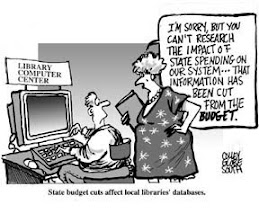
Budget cuts affecting local library
Here is some information about how the economy is affecting a local library here in southeast Michigan. It was recently announced that the City of Livonia has proposed to cut $450,000 in funding to its libraries for the city's 2010 budget. This would result in the closing of two of the branches on alternating days and would likely result in layoffs of library employees. The proposed cuts are already being challenged by members of the Livonia Library Commission. They bring up points like the fact that more and more people are using the libraries because of the economic troubles. Therefore, the library should not receive such a big cut. I think this is a valid point. However, cities are being forced to make budget cuts. Why is it that libraries seem to be one of the first things to be affected concerning budget cuts? Is it out of necessity or do city planners value libraries less than other services? How important are libraries to a city or community? I feel that these are the types of questions that more and more cities will have to address during the economic crisis.
Subscribe to:
Comments (Atom)


 Posts
Posts

